How to use the new PHP enum in Laravel
Jan 12, 2022 by Arnaud Becher

PHP 8.1 introduced long awaited support for built-in Enums. There is no more need for custom solutions in your Laravel projects since Laravel with its 8.69 release has your back.
We’ll take a really simple example of a blogpost model with a publication state that can be draft or published. As it will be stored in database, we used a “backed” Enum. It means that each value is associated with a string.
namespace App\Enums;

enum BlogpostState: string
{
    case DRAFT = 'state_draft';
    case PUBLISHED = 'state_published';
}
Entity model
When creating your database schema, you can use eloquent’s“string” type for the state column as it will store the Enum’s backed value as a string: ‘state_draft’ or ‘state_published’.
public function up()
{
    Schema::create('blogposts', function (Blueprint $table) {
        ...
        $table->string('state');
    });
}
Now comes the great part. You can use the new casting in your Blogpost model and it allows your state model attribute to be casted to/from an Enum:
namespace App\Models;

class Blogpost extends Model
{
    protected $casts = [
       'state' => BlogpostState::class,
    ];

}
Then you’ll get the enum when interacting with the state attribute:
>>> dd($blogpost->state);
=> App\Enums\BlogpostState {
     +name: "DRAFT",
     +value: "state_draft",
   }
So for example you can now compare the state to the Enum directly:
public function isPublished()
{
    return $this->state === BlogpostState::PUBLISHED;
}
Or access the backed value stored in database if needed:
>>> dd($blogpost->state->value);
=> "state_draft"
Also if you try to create or update a blogpost with an invalid state value, you’ll get an immediate PHP error:
>>> $blogpost->update(['state' => 'state_foo']);
=> PHP Error: "state_foo" is not a valid backing value for enum
"App\Models\Enums\BlogpostState"
The state’s enum can have methods,
public function label(): string
{
    return match($this)
    {
        self::_DRAFT_ => 'Draft...',
        self::_PUBLISHED_ => 'Published!',
    };
}
that could be used directly with your model:
>>> $blogpost->state->label();
=> "Draft..."
Validation rule
When you want to make sure an input match an enum, you can use a new laravel rule:
namespace App\Http\Requests;

class BlogpostRequest extends FormRequest
{
    public function rules()
    {
        return [
            "state" => [
                 "required",
                 new Enum(BlogpostState::class)
            ],
        ];
    }
}
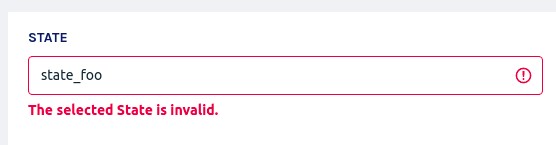
And it’s pretty straightforward. Now your request only accept enum’s backed values: ‘state_draft’ or ‘state_published’.
Factory
Also, when you want to seed a blogpost, you can now use enum directly in your factory:
namespace Database\Factories;

class BlogpostFactory extends Factory
{
    public function definition()
    {
        return [
            ...
            'state' => BlogpostState::DRAFT,
        ];
    }
}
Route bindings
Since Laravel 9, there is now implicit route binding with enum. So you can type-hint your enum and Laravel will automatically cast the string value from the URL :
Route::get('/blog/{state}', function(BlogpostState $state) {
    // here $state is an enum instance
});
In our example, both
- https://mysite.com/blog/state_draft
- https://mysite.com/blog/state_published
are valid URLs. But if URL does not match any of the enum’s values, you’ll get a 404 error (Ex: https://mysite.com/blog/state_foo).
I think we’re done here. Thanks for reading !